
- Click image to enlarge
Across the Chasm of Credulity
Series:
Sanctioned Blindness
Artist:
De Anna
Created:
Medium:
Dimensions (In.)
Edition:
Description:
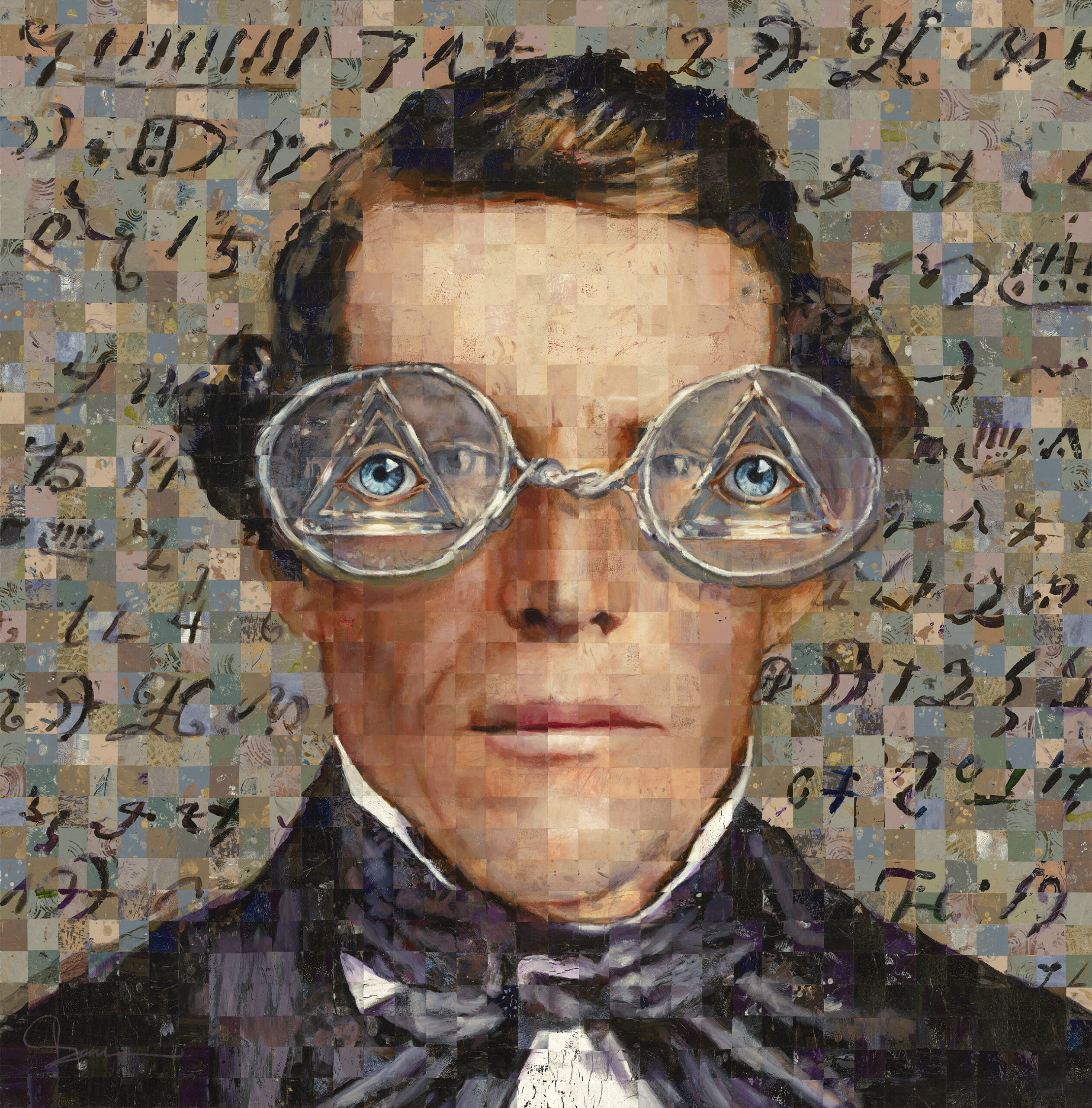
“Across the Chasm of Credulity presents the instruments Joseph Smith claimed could translate ancient language, oversized spectacles he called the Urim and Thummim, or the Interpreters, shown here on his face.
The characters translated through them appear in the background. A Columbia University classics professor was consulted to verify them. He later wrote that what Joseph Smith and Martin Harris claimed he said bore no resemblance to what he said.
Joseph Smith eventually abandoned the spectacles in favor of a stone placed in a hat. Then that story stopped being told too.
What remains is a pair of oversized spectacles, a script no one could read, and a man asking the world to cross a very wide chasm of belief based on very little evidence.”
NOTES:
Framed
COA#
Registered Copyright
Artist Statement:
“Across the Chasm of Credulity is the first painting in the Sanctioned Blindness series. It presents the instruments Joseph Smith claimed could translate an ancient language, oversized spectacles he called the Urim and Thummim, shown here on his face.
Joseph Smith is shown wearing them on his face as an artistic interpretation. Historical accounts describe objects mounted on a rod connected to a breastplate, held before the eyes rather than worn independently. The accounts vary considerably in their physical description. Different witnesses described different things. What the accounts agree on is that Joseph Smith used them briefly, then stopped, favoring a stone placed in a hat instead. Then that story stopped being told too.
The name shifted across accounts, Urim and Thummim, Interpreters, spectacles. Joseph Smith’s mother, Lucy Mack Smith, described them using language that historian D. Michael Quinn identifies as consistent with regional folk magic terminology for seer stones. Her description is consistent with regional folk magic terminology of the period.
The all-seeing eye at the center of each lens is artistic liberty. The eye and triangle belong to Freemasonry; a tradition Joseph Smith would later draw on extensively. The connection is intentional.
The Reformed Egyptian characters in the background were brought to Charles Anthon, a professor of Greek and Latin at Columbia College, by Martin Harris in 1828, hoping for scholarly authentication. Anthon’s expertise was classical languages, not Egyptian. His opinion on Reformed Egyptian characters was that of an informed outsider at best. His own two written accounts of the visit, from 1834 and 1841, contradict each other. What both accounts agree on is that he told Harris the document appeared to be a fraud.
The painting was rendered from reference material derived from the daguerreotype discovered in 2022 within a Smith family locket, identified by the historians who examined it as the only known photographic image of Joseph Smith. Its existence had long been supported by testimony from Joseph Smith’s own son. For generations, believers knew Joseph Smith’s face only through painted portraits and sketches, each reflecting the artistic conventions and interpretations of their time. The daguerreotype offered something different. This painting works from that image.
What remains is a pair of oversized spectacles, a script no one could read, and a man asking the world to cross a very wide chasm of belief based on very little evidence.”